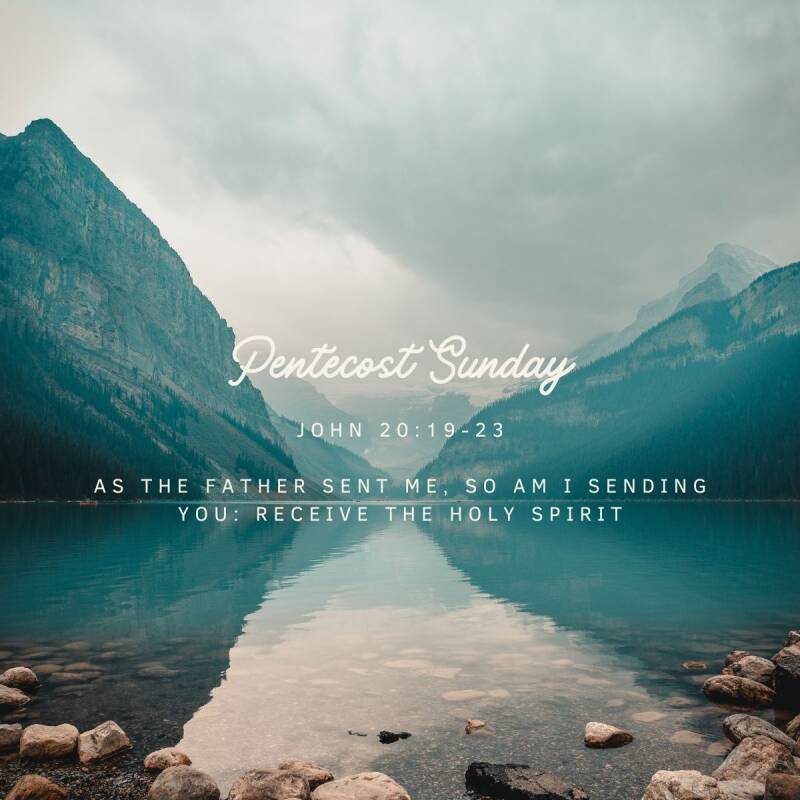

In the evening of the first day of the week, the doors were closed in the room where the disciples were, for fear of the Jews. Jesus came and stood among them. He said to them, ‘Peace be with you’, and showed them his hands and his side. The disciples were filled with joy when they saw the Lord, and he said to them again, ‘Peace be with you.
‘As the Father sent me,
so am I sending you.’
After saying this he breathed on them and said:
‘Receive the Holy Spirit.
For those whose sins you forgive,
they are forgiven;
for those whose sins you retain,
they are retained.’
On this Sunday, we conclude the Paschal season with the Solemnity of Pentecost, celebrating the beginning of the Church, the Mystical Body of Christ. Today we commemorate the birthday of the Church.
After fifty days of the Resurrection, the Lord sends the Holy Spirit to establish the community of believers.
On this day, the Church celebrates the birth of the Holy Church. In the Gospel, the Apostles proclaimed the Good News with courage, passion, and love to the Lord. The fruit of freedom was joy—even at the price of death—as they desired to proclaim what they had witnessed: Jesus Christ, the Conqueror of death and sin.
Something remarkable happened: though they were Jews, on the day of Pentecost they spoke in different languages, and many people from various communities of the Middle East could understand them.
This carries profound meaning: it is the universal language of the liturgy. Although we use our native tongues, the Church enables us to communicate through the same liturgy, the same prayer. This is the gift of the Mystical Body of Christ. We are all united in the same life of prayer, especially during Holy Mass. This is the work of the Holy Spirit throughout the world; we pray to God with the same liturgical structure.
The Third Person of the Holy Trinity enables us to share the same dignity; we are equal before God. Although we have hierarchy in the Church, which indicates different ministries and roles, we believe in the Holy Spirit who unites us. We pray to God with the same dignity as the Body of Christ, for we are members of the same body.
The Gospel of John speaks about the forgiveness of sins and the power of reconciliation given to the Apostles and their successors. In the Sacrament of Reconciliation, the Holy Spirit purifies us from sin through the divine love, making us pure before God.
This day reminds us how abundantly we are blessed from above: as members of the Church, we share the same dignity, receive the gift of forgiveness, and experience the renewal of spirit. Amen.
Wieczorem w dniu zmartwychwstania, tam gdzie przebywali uczniowie, choć drzwi były zamknięte z obawy przed Żydami, przyszedł Jezus, stanął pośrodku i rzekł do nich: "Pokój wam!" A to powiedziawszy, pokazał im ręce i bok. Uradowali się zatem uczniowie, ujrzawszy Pana. A Jezus znowu rzekł do nich: "Pokój wam! Jak Ojciec Mnie posłał, tak i Ja was posyłam». Po tych słowach tchnął na nich i powiedział im: "Weźmijcie Ducha Świętego! Którym odpuścicie grzechy, są im odpuszczone, a którym zatrzymacie, są im zatrzymane".
W tę niedzielę kończymy okres paschalny uroczystością Zesłania Ducha Świętego, celebrując początek Kościoła, Mistycznego Ciała Chrystusa. Dziś wspominamy narodziny Kościoła.
Po pięćdziesięciu dniach od Zmartwychwstania, Pan zsyła Ducha Świętego, aby ustanowić wspólnotę wierzących.
W tym dniu Kościół celebruje narodziny świętego Kościoła. W Ewangelii Apostołowie głosili Dobrą Nowinę z odwagą, pasją i miłością do Pana. Owocem wolności była nie tylko cena śmierci – ale pragnienie by głosić to, czego byli świadkami: o Jezusie Chrystusie, Zwycięzcy śmierci i grzechu.
Wydarzyło się coś niezwykłego; chociaż byli Żydami, Apostołowie w dniu Zesłania Ducha Świętego mówili różnymi językami, a wielu ludzi z różnych zakątków Bliskiego Wschodu mogło ich zrozumieć.
Niesie to głębokie znaczenie: jest to uniwersalny język liturgii. Chociaż używamy naszych własnych języków, Kościół mówi w komunii poprzez tę samą liturgię, tę samą modlitwę. To jest dar Mistycznego Ciała Chrystusa. Wszyscy jesteśmy zjednoczeni w tym samym życiu modlitwy, w tym samym Mistycznym Ciele Chrystusa. W dziele Ducha Świętego na całym świecie modlimy się do Boga tą samą strukturą liturgiczną.
Trzecia Osoba Trójcy Świętej umożliwia nam dzielenie się tą samą godnością; jesteśmy równi przed Bogiem. Chociaż mamy hierarchiczność w Kościele, która wskazuje na różne role, wierzymy w Ducha Świętego, który nas jednoczy. Modlimy się do Boga z tą samą godnością jako Ciało Chrystusa.
Ewangelia Jana mówi o przebaczeniu grzechów i mocy pojednania danej Apostołom i ich następcom. W Sakramencie Pojednania Duch Święty oczyszcza nas z grzechu poprzez Boską miłość, czyniąc nas pojednanymi z Bogiem.
Ten dzień przypomina nam, jak obficie jesteśmy obdarzeni z góry: jako członkowie Kościoła dzielimy tą samą godnością, modlimy się tą samą liturgią I otrzymujemy dar przebaczenia i doświadczamy odnowy ducha. Amen.
Add comment
Comments
Duchu Święty, oddaje się Tobie bez reszty.